
Chennai’s real estate market has been on a tear. New highways, IT corridors along OMR, and the city pushing outward toward Siruseri, Thandalam, and Padur have made plotted developments one of the hottest buys in town. But for every buyer who locks in a solid deal, there’s another stuck with a legal headache or a plot they can’t build on.
If you’re figuring out what to check before buying a plot, this guide covers the mistakes that trip up most buyers and how to avoid them. Whether you’re browsing plots for sale in Chennai or already shortlisting sites, read this before you sign anything.
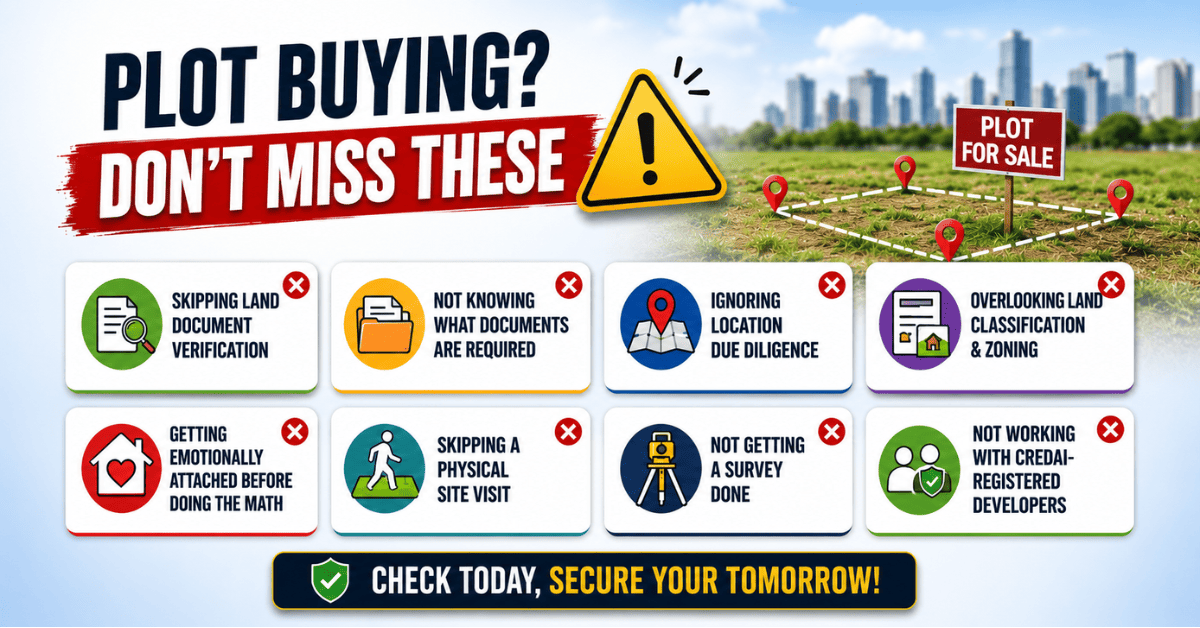
1. Skipping Land Document Verification
Here’s how it usually goes: you see a plot in a nice layout, the price feels right, the sales guy is persuasive, and you pay a booking amount that same weekend. Land document verification? You figure you’ll get to it later. Except “later” sometimes means after you’ve already paid 30% of the total cost, and that’s when you find out the seller’s brother has a court case claiming half the property.
This is the most expensive first-time land buyer’s mistake you can make. And it happens constantly.
Before you pay anything, get a property lawyer (not the seller’s lawyer, your own) to pull records and confirm the non-negotiables. Does the seller actually own this land with a clean chain of title going back 30 years? Are there court cases, loans, or liens attached to it? Do the revenue records, the patta, chitta, and survey number actually match the plot they’re selling you?
Chennai’s outskirts are full of plots with messy ownership histories: joint family land where succession was never formalized, agricultural land “converted” on paper but not in reality, and properties where one sibling sold without the others’ consent. A proper title search costs you maybe ₹5,000–10,000. Skipping it can cost you lakhs.
2. Not Knowing What Documents Are Required to Buy Land
Most first-time buyers think the sale deed is the whole story. It’s not. The sale deed is just the receipt. What documents are required to buy land goes well beyond that, and if you don’t collect and verify each one, you’re setting yourself up for problems that might not surface for years.
Here’s the paperwork you actually need:
- Title deed chain: Going back 30 years. Not just the current sale deed, but the full history of who owned this land and how it changed hands.
- Encumbrance Certificate (EC): From the sub-registrar’s office. This tells you if someone has a mortgage, lien, or legal claim on the property. Get it for the full 30-year period.
- Patta and Chitta: Revenue records that confirm the owner’s name and whether the land is classified as residential. If it still shows as agricultural, that’s a red flag.
- DTCP or CMDA-approved layout plan: No approval means no building permission down the line.
- RERA registration number: Tamil Nadu RERA protects you as a buyer. If the developer hasn’t registered, ask yourself why.
- Property tax receipts: Showing the seller has been paying regularly with no arrears.
- Survey sketch and FMB: To confirm the plot boundaries and area match what you’re being told.
One missing document might not seem like a big deal at signing, but it becomes one when you apply for a building permit or try to resell and the local body flags your paperwork as incomplete.
3. Ignoring Location Due Diligence
Price per square foot means nothing if the area floods every October or has no reliable water supply. This is another frequent first-time land buyer’s mistake: picking a plot based on price alone without actually studying the location.
Before finalizing, find out whether the plot is on a proper paved road or a narrow village path, whether the area has municipal water or depends on borewells, and whether it has a history of flooding (ask locals, not the seller). Check what schools, hospitals, and shops are nearby, and whether any promised infrastructure like metro lines or highway connections has an actual government-backed timeline.
4. Overlooking Land Classification and Zoning
A lot of buyers assume that if a plot is being sold in a residential layout, the land must be classified as residential. That’s not always true. Plenty of plots on Chennai’s outskirts sit on land that’s still classified as agricultural in the patta, and if the conversion wasn’t done through the proper legal process, your purchase can be disputed.
Pull the patta yourself and check the classification before signing. You also want to look at zoning regulations for the area, because they control how tall you can build, how much of the plot you can cover, and how far your walls need to be from the boundary.
5. Getting Emotionally Attached Before Doing the Math
There’s a reason developers invest so much in 3D renders and model clubhouses: they want you to picture yourself living there before you’ve thought about whether the deal makes financial sense. You visit a site on a pleasant morning, the sales team walks you through the amenities, and by the time you leave you’re picking out paint colours for a house you haven’t budgeted for.
Force yourself to run the numbers first. Add up the total cost after registration, GST, legal fees, and development charges. Compare what similar plots are selling for within a couple of kilometres. Look at the builder’s older projects and whether buyers there are happy. If the math doesn’t support the purchase, it doesn’t matter how good the site looked on a Sunday morning.
6. Skipping a Physical Site Visit
NRI buyers are especially prone to this. They browse listings online, watch a virtual walkthrough, check the location on Google Maps, and wire money without setting foot on the land. The problem is that photos only show you what the seller wants you to see. That “lake view” plot could be next to a stagnant pond that breeds mosquitoes half the year, and the “wide approach road” might only exist on the layout plan.
Visit the site at least twice, on different days if possible. Walk the plot, check internal roads and drainage, and talk to people who’ve already bought in the same project. A ten-minute conversation with an existing buyer will give you more honest information than anything the sales team puts together.
7. Not Getting a Survey Done
Boundary disputes are among the most common property cases in Tamil Nadu, and they almost always come down to someone not getting a proper survey done before buying. Get an independent licensed surveyor to measure the plot and compare their findings with the FMB and the approved layout plan. If there are discrepancies, sort them out before registration, because fixing boundary issues after purchase is expensive and painfully slow.
8. Not Working with CREDAI-Registered Developers
Anyone can print a brochure and call themselves a developer. CREDAI membership won’t guarantee a flawless experience, but it tells you the builder has agreed to a code of conduct and is answerable to an industry body, which is more than you get with a random name on a hoarding.
In Chennai’s outer suburbs, new developers show up every few months with flashy renders and aggressive pricing. Before you hand over money, drive to one of their older projects, knock on a few doors, and ask residents how the experience was. That 30-minute conversation will save you more grief than any Google review.
Wrapping Up
Plot buying in Chennai isn’t complicated, but it punishes laziness. Most of the mistakes on this list come down to skipping steps because you got excited or trusted someone’s word over paperwork.
Know what to check before buying a plot. Get the titles verified, confirm approvals yourself, walk the land, and read the sale agreement line by line before you transfer a single rupee. Verifying your land documents alone can save you from years of legal trouble.
IYRA Developers is a CREDAI-member developer with 1,000+ clients across Chennai. Their projects in Siruseri, Thandalam, Padur, and Adyar come with DTCP approval, RERA registration, and clear titles. If you’re actively searching for plot in Pallikaranai, they’re worth a site visit.
“`